Thứ Tư, 30 tháng 9, 2009

Win in China - Interview With Robert A. Compton

I reviewed the documentary Win in China yesterday. Today, I'm going to post a transcript of the discussion I had with the producer of the film, Robert A. Compton.

Compton is a businessman with lots of experience in entrepreneurship and venture capitalism. In recent years, he's had a lot of interaction with both China and India.

In addition to business dealings, he has also produced two films. His first was Two Million Minutes, which is about the state of high schools in the US, China, and India. Encouraged by the huge success of 2mm, he's continued to make films. His second is Win in China.

Last week, I had a very insightful discussion with Mr. Compton about his film and China in general. Here is what he had to say:


Mark's China Blog (MCB): How did you find out about the reality show "赢在中国?" What about the show drew you in and made you want to make a film about it?

Robert A. Compton (RAC): I heard about the show from a Chinese interpreter of mine. He knew someone who was working on the show. He told me the premise and it sounded like a great way to get in tune with China's huge growth in entrepreneurship.

China is the most entrepreneurially active country in the world. But the thing is that they keep things close to the vest. Americans, by and large, don't know what is going on there. Many Americans still have this view that China is exclusively an agrarian society. We don't understand the massive government investment in business infrastructure that is going on over there.

MCB: The simple fact that the show 赢在中国 happened shows just how comfortable China's leadership is with promoting capitalism. Tell me more about the investment in businesses and entrepreneurs that the Chinese government is making.

RAC: With the mass migration from the countryside to the cities, China needs to absorb twenty million jobs every year just to break even. China doesn't want entrepreneurs, it needs entrepreneurs.

The show, 赢在中国, was one way of encouraging more people to get involved in the process of creating businesses. But the investment runs much deeper than mere encouragement. Every university in China has a strong entrepreneurship department. Most have at least ten professors on faculty.

Developing entrepreneurship is part of a broad plan. The Chinese are very serious about developing a nation of risk-takers and business owners. As a filmmaker, this is something I want the rest of the world to know about.

MCB: The theme of China's change from collectivism to individualism is featured throughout "Win in China." How do you understand this change from "Mao to the market" took place? How far into the transition do you think the country is?

RAC: The real trigger was Deng Xiaoping. It was a series of baby steps, really. Deng pushed it along. His endorsement of the private sector was a green light for the entire country to begin making money.

The turn of the millenium saw another important step. That's when the government came in and stepped up its investment in education and entrepreneurship. Ten years ago, most people couldn't send their kids to a university. Now, Chinese universities are open to a much larger segment of the population. And in addition to simply making higher education more affordable, the government has also made it a priority to make sure that those universities, which more people are going to, are developing a new generation of business leaders.

There are over 120 million Chinese people involved in entrepreneurial activity. That's nearly the size of the entire US workforce. Patent filings are on the rise. Students at Qinghua University are switching majors from engineering to business in droves. China has made remarkable strides in accepting capitalism in a very short period of time.

MCB: I found the training aspects of the show very interesting. Jack Ma and other industry leaders came in to teach the contestants about IPOs, "start-up capital," and other financial concepts. Education of the audience was a key part of the show. What does the average 老百姓 (common man) know about entrepreneurship and/or business. What did they learn from the program 赢在中国?

RAC: Despite being repressed a few decades ago, the Chinese people have a long history of business and entrepreneurship. It's hard for me to say how much the average person knows. What exactly does the average American know about these things? I think that, despite China's recent history of repression and state-run industries, their knowledge of business and finance is about the same as an American's.

赢在中国 was wildly popular. Millions upon millions of people tuned into the show. It had to have had a big impact on those viewing. It's astounding to think that the sentiment in China has changed to the point where watching people compete for millions of dollars on CCTV is acceptable. The mere fact that the government signed off on the show is a huge endorsement of capitalism. Add on top of that that the show was a runaway success and it shows that the average Chinese person is hungry for the opportunity to get rich.

Throughout the show, CEOs and business leaders were called "heroes." Chinese people aspire to do the same things in business that these people have done. Jack Ma is a rock star in China.

MCB: One of the judges/creators of the show was quoted in the film saying, "In today's China, anyone can win." Zhou Yu (the Wolf) was the personification of this. His character is the most memorable from the television show and your movie. His name is "the Wolf" because of his cut-throat approach. Throughout the show he implemented questionable business ethics and bent the rules for his advantage. Later in the show on the finale, one of the judges said he "represents the Chinese spirit" and he also won the popular vote of the viewers.

Why was "the Wolf" so popular? Do you think he represents the ethos of the Chinese entrepreneur?

RAC: I believe the Wolf does personify China's entrepreneurship ideals. Watching the Wolf, seeing his aggressiveness, it really did make people uncomfortable. Yet he captures the spirit of today's Chinese business people.

The Wolf probably didn't finish high school. He would never say exactly what his education level was. This appealed to the common Chinese person watching the show. He truly pulled himself up by his bootstraps. The Wolf helped everyone, even those who haven't yet been lifted by China's booming economy, feel as though they have a chance to get rich and have a better life.

If I had been a judge on the show, I would've chosen the Wolf to win the competition. Great entrepreneurs are strong willed. Now, I'm not sure how well he'd do in a Board of Directors meeting. But I do know that since the show completed in 2007, his business is absolutely booming whereas the other finalist on the show is struggling.

MCB: Talk about China's growth and what it means for America.

RAC: We've never faced an entrepreneurial competitor that's four times as large as us. There's an old Red Army saying, "Quantity has a quality all its own." There are over two hundred venture capital firms in Beijing. Now, we have to look at competition coming from Asia where in the past, we only had to worry about domestic firms.

China is already killing us on battery technology and electric cars. Warren Buffet invested $250 million in BYD last year. Now that investment is worth $9 billion. BYD electric cars are all getting between one hundred and one hundred and forth miles a charge and cost $10,000. GM just announced that its Volt will be released soon. It's going to get about forty miles a charge and will cost $40,000.

The Chinese economy is here to stay. We need to be prepared to meet its challenge.

MCB: What do you think about China and America's responses to the financial crisis?

RAC: With its stimulus, China is currently doubling the size of its ports, expanding its rail lines, and rebuilding its energy grid. Compare that to America. We're pouring billions of dollars on failed twentieth century businesses and industries. Their package is building while ours is bailing.

Which country do you think is preparing better for tomorrow?

There are a lot of problems with China's leadership and I certainly don't endorse one-party rule. But there is something to be said for what they're doing. The top leaders in China are all engineers. How many engineers are in our Congress? I know we have a lot of lawyers, but I'm pretty sure there aren't many engineers. Engineers approach economics and growth very methodically. Chinese leadership is proving to be very analytical. Their planning can be seen in the fact that the economic crisis for them means only 8% growth.

MCB: Do you think that these stimulus projects, not being driven by markets but instead by government, could be fueling mis-allocation?

RAC: I'm not sensing over-heating. I feel like China will be able to grow into over-capacity it is creating. But I'm not an economist and I don't study macro-economic numbers. I'm speaking from what I'm seeing in the business community.

MCB: What will China look like in 25 years?

RAC: China's economy will pass the United States' in about twenty five or thirty years. That seems to be the consensus from economists. Another 400 million people will be brought out of poverty. They will join the 400 million who have already been brought out of poverty in the past couple decades.

China is going to dominate battery technology and electric cars. They're doing great in green technology across the board right now.

Once Chinese become consumers, China will be the largest market. This will present a challenge to US companies. Business in China is a very subtle and complex proposition.

MCB: Thanks a lot for your time, Mr. Compton. It's been a pleasure speaking with you.

RAC: Thank you.

I'd like to thank Mr. Compton for sharing his time with me. I really enjoyed hearing his take on what is going on in China right now. Again, you can find out more about his film here.

Thứ Ba, 29 tháng 9, 2009

Win in China - Review

A few weeks ago, I received an email asking me to review a documentary about entrepreneurship in China. The film, called Win in China, produced by Robert A. Compton, sounded like an interesting project and I jumped at the opportunity to view the film, review it, and then interview Mr. Compton.

Today, I'm going to post my thoughts on the movie.


"Win in China" is a documentary about entrepreneurship in China framed by highlighting the Chinese reality TV show, "赢在中国" (literally "Win in China"). Compton's film shows exclusive behind-the-scenes footage of the reality show and has extensive interviews with both the creators, contestants, and observers of the show. The TV show, "赢在中国," is now, in 2009, in its third season. Compton's documentary looks at the first season of the show in 2006-2007.

The reality show's basic premise had contestants entering a business plan competition with more than $5 million (US dollars, not RMB) in prizes. Think the Chinese version of Donald Trump's "The Apprentice." The winner of the contest received $1.5 million for their business (that sure beats Trump's prize of getting a job with Trump Industries!). To win the competition on "赢在中国," the contestants had to impress a panel of judges as well as the viewers watching, who could text message in their votes for who they thought performed best. The judges of the show were many of the top business men in China, including Alibaba.com's CEO Jack Ma (Ma is widely known as "the Bill Gates of China").

The documentary begins by laying the scene that is present-day China. This might be a review for China Hands already familiar with the ins and outs of contemporary China. But to anyone unfamiliar with Deng Xiaoping or the story of "Special Economic Zones" like Shenzhen, this introduction is very helpful in, literally, seeing what has happened in China over the past twenty plus years.

As anyone who's been to China in recent years knows, Chinese people no longer wear Mao jackets or carry little red books. Executive Producer, Wang Lifen, of the reality show, "赢在中国," is quoted in the documentary saying, "Entrepreneurs are the biggest heroes in Chinese society. Many came from nothing, yet they've created so much." Indeed, China today could not be further from the China of Mao, the "Great Leap Forward," or collectivized farming. Compton's film wants to dispel any notions from those in the West who don't know China intimately that Chinese people still think in terms of Maoism or Marxism.

One of the most interesting parts of the documentary is when a group of China's industrial leaders trained and lectured the contestants on the show. Contestants, and, of course, the millions of Chinese watching the show, were given lessons on IPOs, start-up capital, and other basic entrepreneurial practices by Mr. Ma and many of the other top executives in China. The audience was given a step-by-step how-to on how to become a successful business man.

"赢在中国" was meant to be entertaining for the masses. But there was a much bigger reason why the show happened: the Chinese Communist Party wanted more people to become better entrepreneurs. The show, being broadcast on China's Central Television in Communist China, was, essentially, capitalist propaganda. This contradiction, highlighted well by Compton's film, is one of the most fascinating aspects of contemporary China.

The theme of picking one's self up by the boot straps and, in a larger picture, China's transformation from a collective to individualistic society is another main theme of Compton's documentary. One of the creators of the reality show said, "In today's China, anyone can win." This mantra is what the CCP wanted to promote with the show. China needs millions more entrepreneurs if the country's economy is to continue growing at the break-neck pace it has been moving.

The most memorable character from the TV show, and, thus, Compton's documentary, is the contestant, Zhou Yu. Zhou personifies this notion that peasants in China can go from, as one of the commenters in the movie put it, "farming to Ferraris." Zhou was born in rural Hebei Province and (most likely) did not graduate from high school (Zhou is very coy about how much formal education he's actually received).

Zhou's nickname is "the Wolf" for his cut-throat business practices. During competitions, he spied on the other team and lied to third-party participants trying to get information. In other instances, he pushed the rules of the show as far as he could. He wanted to win and tried to by any means possible.

His practices, many of which were questionable to me, were debated by the shows judges and audience. While the other contestants on the show didn't appreciate the Wolf's "win-at-all-costs" business practices, the audience sure did. He repeatedly won the popular vote of the Chinese people watching the show. One of the judges even went so far to say that "the Wolf represents the Chinese spirit."

I won't tell you how the contest ends. It does have a twist and controversy. You'll have to view the film to see whether the Wolf is crowned the ultimate winner of the show.

Compton's "Win in China," clocking in at about an hour with additional interviews added, is worth checking out. The documentary's interviews, footage of contemporary Chinese business practices, and insight into Chinese culture make it worthwhile.

But I believe the biggest reason to watch the movie is to get familiar with the most memorable character - the Wolf. The Wolf is the ideal businessman for contemporary Chinese people. Understanding him, and to a larger extent Chinese businessmen and China's current attitudes towards business, will give one a much deeper understanding of China going forward and would be advantageous for those doing business in China to know about.

I had a very interesting conversation with the producer of the documentary, Robert A. Compton, last week. We covered a wide-ranging array of issues. Check back soon for a transcript of the interview.

Thứ Hai, 28 tháng 9, 2009

The Other Side of Wind Power

China's been lauded a lot for its efforts in going green. Indeed, China does seem to be taking climate change seriously. But at the same time, China, and the rest of the world, have a long ways to go in terms of weening itself off of carbon-emitting energy sources.

From The Wall St. Journal:

Photo from CS Monitor

SHANGHAI—China's ambition to create "green cities" powered by huge wind farms comes with a dirty little secret: Dozens of new coal-fired power plants need to be installed as well.

Part of the reason is that wind power depends on, well, the wind. To safeguard against blackouts when conditions are too calm, officials have turned to coal-fired power as a backup.

China wants renewable energy like wind to meet 15% of its energy needs by 2020, double its share in 2005, as it seeks to rein in emissions that have made its cities among the smoggiest on Earth. But experts say the country's transmission network currently can't absorb the rate of growth in renewable-energy output. Last year, as much as 30% of wind-power capacity wasn't connected to the grid. As a result, more coal is being burned in existing plants, and new thermal capacity is being built to cover this shortfall in renewable energy.

In addition, officials want enough new coal-fired capacity in reserve so that they can meet demand whenever the wind doesn't blow. This is important because wind is less reliable as an energy source than coal, which fuels two-thirds of China's electricity output. Wind energy ultimately depends on wind strength and direction, unlike coal, which can be stockpiled at generators in advance.

Further complicating matters is poor connectivity between regional transmission networks, which makes it hard for China to move surplus power in one part of the country to cover shortfalls elsewhere.

China may not be alone in having to ramp up thermal power capacity as it develops wind farms. Any country with a combination of rapidly growing energy demand, an old and inflexible grid, an existing reliance on coal for power, and ambitious renewable energy-expansion plans will likely have a similar dilemma. What marks China out as different is the amount of new coal-fired capacity that needs to be added.

...

"China will need to add a substantial amount of coal-fired power capacity by 2020 in line with its expanding economy, and the idea is to bring some of the capacity earlier than necessary in order to facilitate the wind-power transmission," said Shi Pengfei, vice president of the Chinese Wind Power Association.

Read On
It's seeming more and more like significant steps towards actually getting away from our CO2-powered lives are not that close to becoming a reality.

That's unfortunate.

Chủ Nhật, 27 tháng 9, 2009

Last Year's Massive Earthquake

Apparently last years Sichuan earthquake was a once in a lifetime phenomenon. Actually, it was a once every four millenia phenomenon.

From AFP:

PARIS — People who were killed, injured or bereaved in the 2008 Sichuan earthquake had the cruel misfortune to be victims of an event that probably occurs just once in four millennia, seismologists said on Sunday.

In a paper published in the journal Nature Geoscience, Shen Zhengkang of the China Earthquake Administration and colleagues said the May 12, 2008 quake comprised a strong seismic wave, unusual geology and the failure of three subterranean "barriers" to resist the shock.

Using Global Positioning System (GPS) markers and data from satellite-borne interferometric radar, the scientists built up a picture of the Longmen Shan fault, on the northwest rim of the Sichuan basin, as it was gouged open by the 7.9-magnitude temblor.

Nearly 88,000 people were killed in what was the largest seismic event in China in more than 50 years.

Read On

Not that it is any consolation for those that were affected, but hopefully nothing like this will happen again for another four thousand years.

Thứ Bảy, 26 tháng 9, 2009

October 1st Approaches

This is a big week for China and the CCP.

From USA Today:

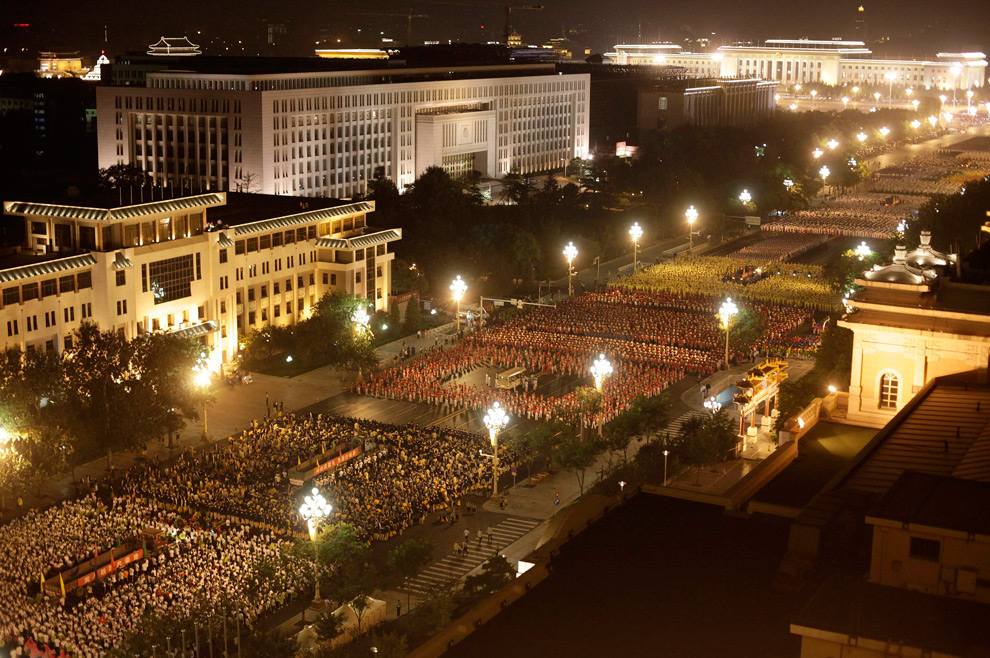
Image from Reuters (click this link to see a large collection of incredible photos of the anniversary's preparation)

BEIJING — With armed SWAT teams, 1 million security volunteers, a celebrity-packed hit movie and a barrage of propaganda, Beijing is gearing up for a burst of pride and patriotism for next week's 60th birthday of the People's Republic of China.

On Thursday, six decades after Chairman Mao Zedong climbed the Tiananmen gate to declare the founding of Communist China, President Hu Jintao will preside over a huge military parade to mark the nation's rising strength and prosperity — and its continuing one-party rule.

After the successful, ambitious Olympics opening ceremony in Beijing last year, the government is leaving nothing to chance.

To prevent collisions when 150 planes do a ceremonial flyover, people are banned from holding kites or balloons or from releasing pigeons in the city's center.

In addition to the heavy police presence already visible, backed by volunteers wearing red armbands, Chinese security chief Zhou Yongkang mobilized what he described as a "security moat" of checkpoints in neighboring provinces to keep out potential protesters, according to the state-run Xinhua News Agency. Zhou has called for a "people's war" to guarantee that nothing — and no one — disrupts the celebration.

Read On
When I heard about this celebration last winter, I didn't have a problem with it. To me, it seemed like the Chinese version of similar celebrations that happen in America and other countries throughout the world.

At some point between last January and now though, I soured on this kind of propaganda. I'm not sure when this exactly happened, but I'm not nearly as tolerant of this kind of stuff as I was. Leaving China, and before that preparing to leave China, surely has something to do with my disillusionment. I believe that my fundamental attitude toward the China and its policies changed while I was living in the Middle Kingdom too.

When I first went to China in early 2006, I didn't know much about China or the CCP. I had a very negative impression going in from the media in the West. Over time, though, I saw that, for the most part, China is a country on the move and Chinese people are generally happy and their lives are getting better. For these reasons, I became more tolerant of the leadership of China and their actions.

The more I got into China news and the more deeply I came to understand the country though, China's methods became less endearing. To me, it seems like the powers that be are more interested in securing their own political hides and the mythical "harmony" than actually treating people like humans or developing the country in a sustainable way.

I'll be interested to see pictures and videos of the events on October 1. But I'm not going to be seduced by the greatness of the day like I maybe would have a year or two ago.

Thứ Sáu, 25 tháng 9, 2009

Photos of the Week - Honeymoon in St. Pete

We finished up our honeymoon yesterday. We went to a resort in St. Petersburg, Florida. It was a really good and relaxing week. We were there from Sunday through Thursday. It was great to go during these times since there were hardly any people there. That's just what we were looking for for our honeymoon.


Here are some of the better photos we took:


Edited out photos


Me (with very stupid hair) and Qian on the beach with a rainbow in the background


Our honeymoon was perfect. We couldn't have really asked for a better few days.

Thứ Hai, 21 tháng 9, 2009

Honeymoonin'

With Qian down on the West coast of Florida. It's incredible. Talk with y'all later.

Bài đăng phổ biến